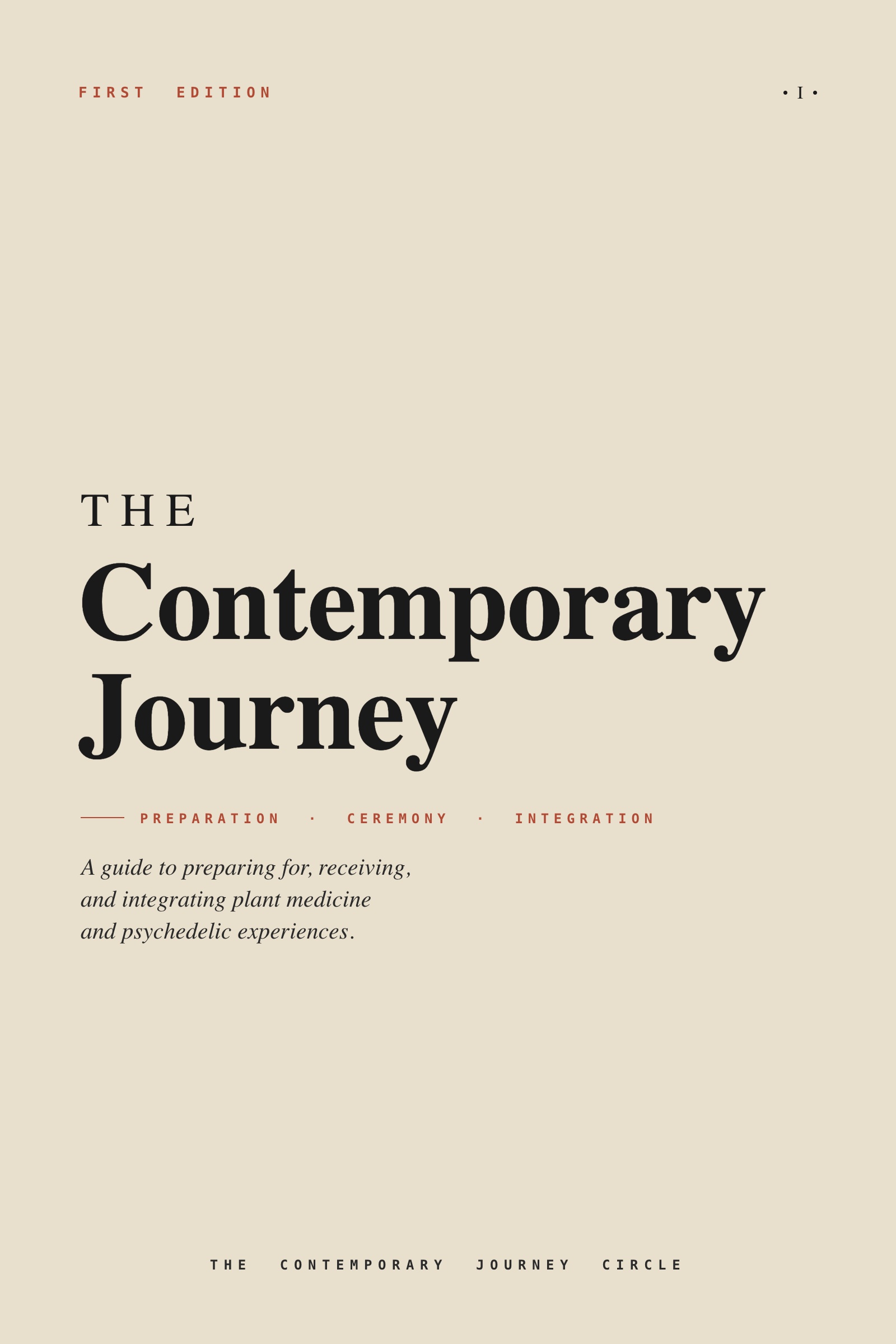
The Contemporary Journey
A guide to preparing for, navigating, and integrating psychedelic and plant medicine experiences.
About this book
The Contemporary Journey is a literary companion for those preparing for, undergoing, and integrating psychedelic and plant medicine experiences. Written by practitioners for readers they respect, it offers philosophy, context, and practical wisdom without prescription.
The book moves through four pillars — Physical, Psychological, Emotional, and Energetic — across the arc of preparation and integration that surrounds ceremony. It does not tell you what to do. It offers structure for questions that have no single answer.
This is not a wellness book. It is not a how-to guide. It is not a scientific survey or a spiritual treatise. It is a companion for the work that happens before and after the medicine — the work that determines whether an experience becomes integrated or remains unfinished.
The writing honors Indigenous lineage explicitly. It carries crisis resources prominently. It acknowledges what it does not know. It was written for the person reading at four in the morning, holding a question they are not quite ready to name.
For the one reading this at four in the morning, in the room they cannot yet leave.
This book began where most beginnings do — in the quiet hours before anyone else wakes, when the questions that daylight pushes aside finally have room to breathe. It was written for the person sitting with a decision they are not quite ready to make, holding a curiosity they are not quite ready to name.
The medicines will be here when you are ready. There is no scarcity.
Chapter overview
- 01
The Quiet Hours
An introduction to the work and who it is for.
- 02
The Four Pillars
Physical, Psychological, Emotional, and Energetic — the framework that structures the journey.
- 03
Physical Preparation
Body, breath, sleep, nutrition, and the nervous system work that precedes ceremony.
- 04
Psychological Preparation
Intention, expectation, set and setting, and the mental architecture of readiness.
- 05
Emotional Preparation
Processing what is already present, making space for what may arise.
- 06
Energetic Preparation
Practices from contemplative traditions, adapted for the contemporary context.
- 07
The Ceremony
Navigation, surrender, and the threshold between preparation and integration.
- 08
Integration Foundations
The first days and weeks after ceremony — what to expect, what to practice.
- 09
Microdosing as Integration Support
Protocols, tracking, and the honest research frame. Extended reference at the website.
- 10
Long-Term Integration
Sustaining the work over months and years. When to return, when to wait.
- 11
Ethics and Reciprocity
The 8 Rs framework, Indigenous lineage, and what practitioners owe to the traditions.
- 12
Finding Support
Therapists, facilitators, retreat programs — how to evaluate, what to ask, red flags.
Three reading paths
Preparing for Ceremony
Start with the preparation chapters (3-6), then read the ceremony chapter (7), then the integration chapters (8-10). Return to the philosophy chapters (1-2) when you have time.
Integrating a Previous Experience
Start with the integration chapters (8-10), then read backwards through ceremony (7) and preparation (3-6). The philosophy chapters (1-2) may reframe what you experienced.
Professional Use
Read straight through. The book is structured to build a complete framework. Pay particular attention to the ethics chapter (11) and the notes on facilitation throughout.
What this book is not
- Not a prescription. The book will not tell you what to take, how much, or when.
- Not medical advice. Nothing in these pages substitutes for professional care.
- Not a romanticization. The work is difficult. The book does not pretend otherwise.
- Not a wellness product. There are no promises of transformation, unlocking, or elevation.
- Not comprehensive. It is a guide, not an encyclopedia. A current bibliography lives at the references page.
Read the first chapter
Enter your email to receive a PDF of Chapter 1 and occasional updates about the project.
The companion workbook
The Workbook translates the book's philosophy into daily practice — four weeks of preparation, a ceremony bridge, and four weeks of integration. It stands alone; you do not need the book to complete a full arc.
View the Workbook